In and interview, Stan Lee said that creating heroes such as Spiderman wasn't all that interesting to him and that the real fun for him was creating the villains that the heroes would have to deal with. It has been said that a person is defined by their enemies. Entire stories have been based on that theme.
There are stories without antagonists. They are often about overcoming obstacles to achieve some goal. Those types of stories are perfectly fine. They are entertaining and often popular.
A good antagonist can drive a story. An antagonist who is a villain can put a story into overdrive. So what makes a really worthwhile villain?
If you want a memorable villain that will really drive your story you need to make them a person without a conscience, a psychopath.
What do I mean psychopath? Well, read the books on the subject. Here are some recommended titles. Read any one of these and you will have a very good handle on what evil is all about.
The Sociopath Next Door
by Martha Stout, PhD
Without Conscience: the disturbing world of the psychopaths among us
by Robert D. Hare, PhD
Snakes in Suits: when psychopaths go to work
by Paul Babiak, PhD and Robert D. Hare, PhD
The Mask of Sanity
by Hervey Cleckley, MD
Not all antagonists are villains. Not all villains are psychopaths. Look at Darth Vader. He eventually acted for the benefit of another and sacrificed himself to save his son from death. No psychopath would ever do that. The most memorable antagonists are villains and are psychopaths.
In addition to being a psychopath to really be memorable a villain must also be entertaining. Making a villain entertaining involves some luck. There are plenty of dastardly villains in stories but not all of them are entertaining. There's not formula to follow to achieve that. On the other hand there are some guidelines for making your villains truly evil.
The first attribute of such a villain is that this particular individual is completely and solely motivated by his or her own self interest, whatever that may be. They well may have friends but they are a friend to no one. They will actively or passively sacrifice anyone, even those who are closest to them, or any living creature for the greatest good of self. When it comes to other entities this particular villain never ever feels their pain.
They manipulate others to achieve their own goals. Their goals are never altruistic. As part of their manipulation they will bestow gifts on others but when they do there is always a very high price for the recipient to pay as the villain's machinations unfold. Giving gifts is looked on as an investment to be collected with steep interest.
To the villain other living creatures, including people, are property. They can also be bargaining chips. So long as they serve the villain well their feelings, desires, well being and health are of absolutely no consequence.
Complete and utter compliance to the villain's wishes are demanded from each of the villain's minions. When he or she has opponents the same is demanded. Punishment is always very harsh for not delivering to the villain what he or she wants. As ruthless as the punishment meted out may be it is never revenge. It is always done with the purpose of setting an example to anyone else who might have ideas of not delivering to the villain what he or she so desires. Punishments meted out are always extremely grim and extremely gruesome.
The villain likes to be in the position of leadership. Often the word power is bandied about with regard to this. Power has nothing to do with it. The villain wants control over others and he or she wants followers to do the heavy lifting and to take the fall for him or her, if and when that becomes necessary.
Those within the villain's inner circle are in the most dangerous position. If the villain ever perceives them to be enjoying too much of a free ride or posing any kind of challenge to his or her leadership position, well, there are always many justifications for disposing of them one way or another.
When a villain attains a top leadership position he or she no longer feels the necessity to hide his or her true nature. Within a hierarchy where they are somewhere below others in the pecking order their behavior adjusts to the situation. For the most part they do not conceal their nature to those beneath them in the chain of command. To those above they put on a very different face. They are almost always regarded by their seniors as the very best employee/follower/member in the place. Those below tend to see more of the truth, but they are generally not in a position to do anything about what they perceive.
Read the suggested books and think about how you can use this information with regard to the creation of your villains. You will make your stories sizzle.
header picture

Wednesday, May 22, 2013

Monday, May 13, 2013
My Clematis Part 1
I have a clematis plant. It came with the place where I live. A clematis is a flowering vine. There are different kids of them and they have different characteristics. This particular type of clematis needs to be cut right back in the fall. Come the spring it sprouts and grows large as if it were a brand new plant.
About two years ago I built a new trellis for the clematis. I got a long strip of wood about 1/4" x 3/4". I cut it into 18" length pieces and drilled five evenly spaced 3/8" holes in each piece. Then I took some sisal rope and constructed a trellis.
The trellis did a pretty good job but it didn't fare well in the weather. I wanted the wood to weather after which I would varnish it. The wood weathered to a nice grey. The sisal rope, which is a natural fibre didn't do so well. It perished in places and the trellis got to looking very ratty.
I took it all down and cut away all the old rope. Then I got some 3/16" braided nylon rope. I put two coats of Varathane on the slats. I went against the instructions. I wiped off the slats but beyond that I did not clean or sand them first. Then I took the rope and the slats and made a new trellis. It turned out much better than my first effort.


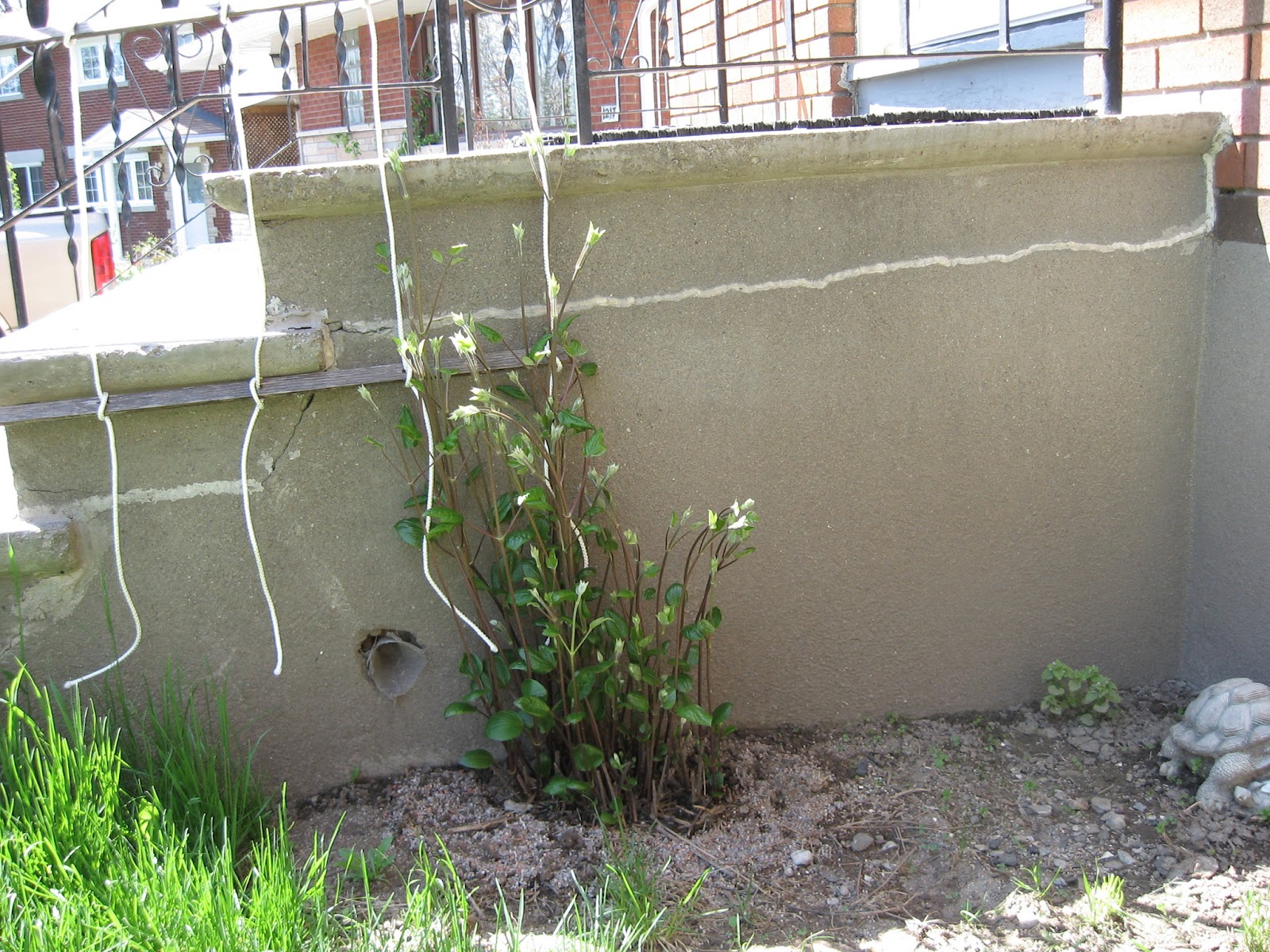


I will be taking pictures of this daily for a while, at least until the clematis reaches its full growth. Part 2 of this should come in about ten to twelve days from now.
About two years ago I built a new trellis for the clematis. I got a long strip of wood about 1/4" x 3/4". I cut it into 18" length pieces and drilled five evenly spaced 3/8" holes in each piece. Then I took some sisal rope and constructed a trellis.
The trellis did a pretty good job but it didn't fare well in the weather. I wanted the wood to weather after which I would varnish it. The wood weathered to a nice grey. The sisal rope, which is a natural fibre didn't do so well. It perished in places and the trellis got to looking very ratty.
I took it all down and cut away all the old rope. Then I got some 3/16" braided nylon rope. I put two coats of Varathane on the slats. I went against the instructions. I wiped off the slats but beyond that I did not clean or sand them first. Then I took the rope and the slats and made a new trellis. It turned out much better than my first effort.
 |
| Here are the rope and the weathered but as yet unvarnished slats. |
 |
| This and the two pictures that follow show the slats and rope assembled and in place. |
 |
| The trellis went up on May 1, 2013. |
 |
| This went up just in time. I had to wait until the temperature got warm enough to put the Varathane on the slats as I did it outside to avoid fumes. That took two days. As you can see the clematis has just sprouted. |
 |
| This and the next picture show the clematis one day after the trellis went up. I have put two cups of granulated vine fertilizer around the base of the clematis and watered it in. At this stage I will water the plant every day as the continuous water will improve its growth. |
 |
| Garden critters like that turtle help the plants grow. They keep the moisture in the ground underneath them. |
 |
| This was taken on May 3, 2013. The following pictures were taken each day up to May 13, 2013. |
 |
| After practicing the knot about four times I tied a bowline around the stalks on the plant that were flopping and in turn tied that to the railing for support. When they finally grab onto something I'll remove the rope. |
 |
| The temperature this day and the day before was very cold. The plant grew but the growth was much slower than it was when it was hotter. |
I will be taking pictures of this daily for a while, at least until the clematis reaches its full growth. Part 2 of this should come in about ten to twelve days from now.
Friday, May 03, 2013
Plant Your Tulip Bulbs Dry
I suppose this is a bit early in the season for this. Fertilizing the plants and cleaning up the garden has brought it to mind.
In the fall, you may plant tulip bulbs. I've seen this on programs on television about plants and people who garden have demonstrated it to me.

They take a bucket of water with them and a small cup like object of some kind. They dig a small hole for the tulip bulb. Then they fill it with water and watch it seep into the surrounding soil. Then they put it the tulip bulb over which they pour more water. Finally they fill over the top with soil and then add more water for good measure.
So what are they actually doing here? They are putting water into the soil around the tulip bulb on a dry day. As well the day they choose is more often than not a dry sunny day. Nothing like good exercise and gardening to make one happy and fit, don't you know.

On a dry sunny day the water they used on the tulip bulb combines with the scent of the bulb. Because it's a dry day and the surrounding soil is dry, the tulip scent laden moisture will leach away from the tulip and some of it will evaporate taking the scent with it into the air.
That scent laden vapour will find its way to any nearby squirrels. Squirrels find tulip bulbs to be quite a nice delicacy and a wonderful addition to their diet. They will follow the scent on the air to the recently planted tulips where they will dig most of them up and eat them. I hear people complaining about this all the time.

So here is what you do to reduce the chance of this happening. Hey, we're talking about squirrels here. There's no sure way to stop them. This will, as I say, put the odds in your favour of the squirrels leaving your bulbs alone.
Plant your tulip bulbs but do not use any water. I can sense you cringing over this but go against everything you've been taught and leave the bucket and cup like thingy that goes with it in storage. It will rain. It will snow. Your bulbs will get all the water they need.
In the rain the whole environment will be wet. The likelihood of any tulip bulb scent rising into the air in a downpour is minimal. Plant your tulip bulbs dry and enjoy more of them coming up the following spring.
In the fall, you may plant tulip bulbs. I've seen this on programs on television about plants and people who garden have demonstrated it to me.
They take a bucket of water with them and a small cup like object of some kind. They dig a small hole for the tulip bulb. Then they fill it with water and watch it seep into the surrounding soil. Then they put it the tulip bulb over which they pour more water. Finally they fill over the top with soil and then add more water for good measure.
So what are they actually doing here? They are putting water into the soil around the tulip bulb on a dry day. As well the day they choose is more often than not a dry sunny day. Nothing like good exercise and gardening to make one happy and fit, don't you know.
On a dry sunny day the water they used on the tulip bulb combines with the scent of the bulb. Because it's a dry day and the surrounding soil is dry, the tulip scent laden moisture will leach away from the tulip and some of it will evaporate taking the scent with it into the air.
That scent laden vapour will find its way to any nearby squirrels. Squirrels find tulip bulbs to be quite a nice delicacy and a wonderful addition to their diet. They will follow the scent on the air to the recently planted tulips where they will dig most of them up and eat them. I hear people complaining about this all the time.
So here is what you do to reduce the chance of this happening. Hey, we're talking about squirrels here. There's no sure way to stop them. This will, as I say, put the odds in your favour of the squirrels leaving your bulbs alone.
Plant your tulip bulbs but do not use any water. I can sense you cringing over this but go against everything you've been taught and leave the bucket and cup like thingy that goes with it in storage. It will rain. It will snow. Your bulbs will get all the water they need.
In the rain the whole environment will be wet. The likelihood of any tulip bulb scent rising into the air in a downpour is minimal. Plant your tulip bulbs dry and enjoy more of them coming up the following spring.
Tuesday, April 23, 2013
Good Place For It
When I was on the board of the Canadian Fallen Firefighters Foundation I was involved in organizing the annual memorial ceremony, which was held on Parliament Hill in Ottawa at the time. I think this happened at the second ceremony, but it might have been the third.
First I have to set this up. The purpose of the ceremony is to honour and remember Canada's firefighters who have died in the line of duty. The Foundation subsidizes family members of firefighters who have died the year before so that they can come to the ceremony. Fire helmets play a role in this.
There is an altar on which there is a helmet placed for each of the firefighters who have died the year before. During the ceremony each family is given a medallion with the name of the firefighter engraved on it and they are presented with a fire helmet.
To do that there is a helmet party. The helmet party consists of firefighters most of whom the families have chosen to present them with the medallion and helmet. These firefighters march in carrying the helmets and place them on the altar and later take them and present them to the families.
One such firefighter who was retired for some years came to Ottawa from Nova Scotia specially to be in the helmet party. I had been introduced to him the day before during the ceremony rehearsal. He was very proud to be there.
On the morning of the ceremony I arrived early, around 6 a.m. for the preparation for the ceremony, which is scheduled to start at 11 a.m. There is quite a lot to do to get ready. Five hours seems like a lot of time but on the day of the ceremony that time really goes fast.
At around 10 a.m. with most of the preparation well underway, I was up on the top steps in front of the Peace Tower with the ceremony stage manager and the two bell ringers waiting for the parade to start. The parade consisted of firefighters in uniform, the bands involved, the honour guards and the helmet party. In order for the ceremony to start at 11 a.m. the parade had to start twenty minutes to half an hour before that, depending on how many firefighters had arrived for it.
I saw an Ottawa Fire Services pumper driving west on Wellington street and I pointed it out to the guys. "Look, Ottawa has sent a crew to participate." Just as it passed the eternal flame its siren went off along with its air horns. Right then the stage manager got a call and answered it with his digital radio.
Our friend in the helmet party from Nova Scotia had just had a heart attack. The other firefighters in the parade immediately went to work with their paramedic skills and the pumper arrived within less than thirty seconds with its defibrillator equipment. An ambulance arrived soon after and took him to the hospital. One of the nurses on duty there was a firefighter's wife. She told me later he got very well looked after and revived very quickly from his ordeal. He was however, very disappointed that he didn't participate in the ceremony.
Monday, April 22, 2013
The Cover for The Seven Second Kiss
First off I think it's too dark. I don't know what to do to change that.
I think the thing that a cover for a book or a poster for a story should answer the question, "What is this about?" without giving it all away. If the cover or poster does its job it will give the prospective customer some clue as to whether what's between the covers would potentially interest them or not. (So maybe a cover tells people what's not in the book as well as what is. I'll have to think about that.)
I may do another more generalized piece on covers at another time. Right now I'm dealing with the cover I finally came up with for my novel, The Seven Second Kiss. So let's put it up here so you can see it and then I can discuss it.

First off, I don't know if I have enough text on the cover. I tend to learn by blundering around and making plenty of mistakes. Fortunately I have survived despite my ignorance and stupidity.
So what is this? This is the centre of a 78 rpm record with a label on it. The title on the record label is the title of the book, and a song within the book. I have not written lyrics for that song but if the book experiences any degree of success, I will do that.
On the label is one view of the New York City skyline in 1934, which is where and when the story takes place. The saxophone outline tells you music is involved and it is also the instrument that Jordan Cropper, Connie's love interest, plays.
Now that I describe all that I'm thinking the cover is actually pretty lame. I have not captured any of the crises or conflicts within the story. Perhaps I'll have to rethink this and change the cover. Having said that I think the cover does tell the potential reader some of what the book is about.
Let's take a look at some of the other ideas I had for a cover. My initial image was a small town residential street at night just after a rain and lit with a street lamp. A young woman, Connie, is walking away from one of the houses carrying a suitcase. In the darkness is a transparent image of a young black man, Jordan, playing his saxophone.
Here's a sketch for that.

I also got a friend who has a saxophone to let me take pictures of it, as I thought I could just use an image of a saxophone with the text over it. That looks OK but it really doesn't tell the story. This is one try at that one.

I think the thing that a cover for a book or a poster for a story should answer the question, "What is this about?" without giving it all away. If the cover or poster does its job it will give the prospective customer some clue as to whether what's between the covers would potentially interest them or not. (So maybe a cover tells people what's not in the book as well as what is. I'll have to think about that.)
I may do another more generalized piece on covers at another time. Right now I'm dealing with the cover I finally came up with for my novel, The Seven Second Kiss. So let's put it up here so you can see it and then I can discuss it.
First off, I don't know if I have enough text on the cover. I tend to learn by blundering around and making plenty of mistakes. Fortunately I have survived despite my ignorance and stupidity.
So what is this? This is the centre of a 78 rpm record with a label on it. The title on the record label is the title of the book, and a song within the book. I have not written lyrics for that song but if the book experiences any degree of success, I will do that.
On the label is one view of the New York City skyline in 1934, which is where and when the story takes place. The saxophone outline tells you music is involved and it is also the instrument that Jordan Cropper, Connie's love interest, plays.
Now that I describe all that I'm thinking the cover is actually pretty lame. I have not captured any of the crises or conflicts within the story. Perhaps I'll have to rethink this and change the cover. Having said that I think the cover does tell the potential reader some of what the book is about.
Let's take a look at some of the other ideas I had for a cover. My initial image was a small town residential street at night just after a rain and lit with a street lamp. A young woman, Connie, is walking away from one of the houses carrying a suitcase. In the darkness is a transparent image of a young black man, Jordan, playing his saxophone.
Here's a sketch for that.
I also got a friend who has a saxophone to let me take pictures of it, as I thought I could just use an image of a saxophone with the text over it. That looks OK but it really doesn't tell the story. This is one try at that one.
I think the cover I am using right now is the best of this lot, though it may not be the best possible cover. Now that I've shared some of this, I have some new ideas to think about.
I Posted All My Construction Pictures of the Canadian Firefighters Memorial Blog
In the fall of 1996 Will Brooks and I decided to make a memorial to Canadian firefighters who had been killed in the line of duty. In September 2012 that memorial was dedicated. Other people will tell you different versions of how this came about but I was involved in it at the beginning and even before that.
Without going into a narrative of how we floundered about, learning what to do and finally making it happen I just want to point out to you that I have made a blog site about the Canadian Firefighters Memorial and I'd like you to go and visit it. Here's the link to it: http://canfimem.blogspot.ca/
I should have started earlier taking pictures of the construction of the memorial. I missed three or four months. Oh, well. Water under the bridge as the cliché goes. I started taking pictures on a weekly basis in June, 2011. Earlier today, I completed posting on the blog site all the pictures I have taken of the memorial's construction.

There will be more pictures to come, as I intend to continue to photograph the site on a regular basis to record its changes in colour through the seasons as well as the growth of the plants on the site.
If you live in Ottawa I urge you to go to the site and experience it first hand. If you live somewhere else, I'll say this. Ottawa is a beautiful city. You'd probably like it here, especially in the warm months. When you come here put the Canadian Firefighters Memorial on your list of things to see here.
If you're a firefighter or a friend or relative of a firefighter, then you should definitely put the Canadian Firefighters Memorial on your agenda.
Sunday, April 21, 2013
Black People are Prominent in The Seven Second Kiss
When I initially conjured images for The Seven Second Kiss one thing that came up right at the beginning was that there would be a black musician who played the saxophone, that he would be older and more sophisticated than the young white woman, and that they would have a relationship. As it turned out Jordan Cropper is not much older than Connie, nor is he very sophisticated. He does, however, play a mean saxophone.
In my initial imagining I had Connie very briefly work in a night club washing dishes before she got hired to sing in a band, which she then went touring with to Atlantic City, Miami, Chicago, and other places in the United States. In the course of that she would experience drug addiction, violent crime, egregious racism, and other sleazy and nasty things.
The story turned out quite differently as she remained in New York City throughout the story. If the book ever finds an audience, I have ideas for a sequel that will involve the elements that were eliminated or reduced from the story. As well since Connie is seventeen in 1934 her life could well extend to the nineteen-nineties over a series of stories. One thing at a time.
One of the inspirations for the depiction of black people in this story was Buck and Bubbles and their appearance in the Danny Kaye movie, A Song is Born. They were also in the Dick Powell movie, Varsity Show. Each time they played janitors who happened to be, as it turned out, very talented musicians and dancers.
Watching the way black people were depicted in movies in those times is downright embarrassing now. "Beulah, peel me a grape." Please! "Feets, don't fail me now." Come on! So, to some degree, I wanted to be a little more realistic. I would like it if some black people were to read my book and tell me whether I succeeded or not.
I couldn't ignore the fact that in the nineteen thirties black people tended to be socially disadvantaged in terms of education and employment, never mind the discrimination. But just because a person is socially disadvantaged that doesn't mean they're stupid or ignorant. I wanted that point to come across very pointedly.
This is the first story I've made available as an e-book. It isn't the first one I've written. I think I have nine others. They need work to get out there otherwise I'd publish all of them today. As has been the case with the other stories I've written the characters I "create" take on a life all their own.
There's Jim. He's named Jim Baskett after the actor who played Uncle Remus in Disney's Song of the South. I love that movie and the book that came out based on it. Jim started out with Uncle Remus in mind but he changed very quickly. For one thing he has a fairly tragic back story.
After Jim, there's Mae Madison, and her best forever friend, Emma. Mae is fiery and feisty. She fearlessly speaks her mind and takes no prisoners. Emma is a softie by comparison but she isn't prone to backing down from anything either. Of the two Mae is the realist and Emma is the dreamer.
There are many black people involved in the story. One other minor character I'd like to mention here is Alva, the stage manager of the Apollo. She is a woman who probably didn't exist in the nineteen-thirties. I based her on the kind of black women in the nineteen-sixties and seventies who very much personified, "black is beautiful." Alva completely and unapologetically embraced who and what she was.
That's a bit of what went into my depiction of black people in The Seven Second Kiss. Was I accurate? Was I fair? I don't really know. I did the best I could do for the story I wanted to tell. I doubt very much that I was accurate. I hope I was fair.
Subscribe to:
Posts (Atom)